Research in conjunction with KITP programming has a greater impact on researchers than research conducted in conjunction with any other facility, according to a study whose findings were published in the Proceedings of the National Academy of Sciences.
In addition to its overall effectiveness at promoting high impact research, KITP has helped create new fields. Here are four examples:
• In the early 1980s, a group of young astrophysicists and particle physicists met for six months at the KITP and created the basic theoretical structure that governed a 25-year effort to understand the cosmic microwave background radiation. Many of the participants became leaders in the new field of particle astrophysics that emerged from that KITP program.
They pioneered the theoretical modeling tools that led to the ability to use cosmic microwave background temperature measurements to construct an almost complete history of the universe and eventually to select the model incorporating dark matter and dark energy.
• From the 1995 program on quantum computing came the proof-of-concept that a quantum computer would be more powerful than classical binary computing systems—envisioning, in effect, the software that would make the quest for hardware not only a worthwhile, but potentially transformative technology.
• In 1998 the KITP hosted the annual string theory conference in conjunction with a six-month string-theory program. String theory envisions all particles detected or hypothesized in high-energy physics as different vibrations of strings in five or six more “extra” spatial dimensions than the traditionally posited three.
The KITP string meeting occurred a month after Juan Maldacena announced his breakthrough insight into a duality that provided theorists with extraordinary computational power. KITP permanent member and leading string theorist Jospeh Polchinski did a study on the effectiveness of that string theory program, indicating that the program had an enormous impact on the field—bringing all the top string theorists together at precisely the right time.
• In 2004 two programs ran simultaneously—one on cold atom systems or Bose-Einstein condensates and the other on strongly correlated electron systems. Bose-Einstein condensation (a big development in atomic physics acknowledged with more than one Nobel Prize) produced a coherent quantum state of cold atoms that Einstein had predicted. The big realization, given impetus via the conjunction of the two programs, is that these coherent quantum states can be used to construct models of condensed matter systems that are more controllable than had been imagined and attained heretofore.
These two communities—one focusing on cold atoms (or, more broadly speaking, quantum optics) and the other focusing on highly correlated electron systems—had little, if any connection, until this concatenation at KITP that is now at the heart of the new field emerging from their fusion. The programs were not accidentally run together because it looked as though the two might benefit from a closer acquaintance, but the magnitude of the actual benefit was unanticipated.
Then there are the pedagogical programs that provide intense cross-disciplinary immersions—of biologists into physics, and physicists into biology, for one example. Another example is the cross between physics and mathematics. These pedagogical programs have emerged as the most frequently accessed of talks in KITP Online Talks. These instructive talks continue a service to the science community.
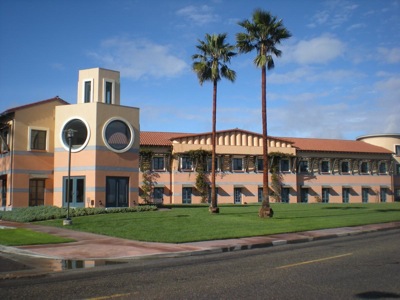 The Kavli Institute for Theoretical Physics (KITP) is the first and foremost scientific research facility where theorists in physics and allied fields congregate, for sustained periods of time, to work together intensely on a broad range of questions arising from investigations at the leading edges of science.
 Science Communication
 Science Education