


Latest News

Now Accepting Applications for Postdocs in Quantum Materials Theory
The Kavli Institute for Theoretical Physics at the University of California, Santa Barbara expects to appoint Postdoctoral Scholars in theoretical physics, beginning September 1, 2023. For more information, and to apply, please visit Academic Jobs Online: academicjobsonline.org/ajo/jobs/22474. Apply by November 1, 2022 for primary consideration.
The University of California is an Equal Opportunity/Affirmative Action Employer. All qualified applicants will receive consideration for employment without regard to race, color, religion, sex, sexual orientation, gender identity, national origin, disability status, protected veteran status, or any other characteristic protected by law.
As a condition of employment, you will be required to comply with the University of California SARS-CoV-2 (COVID-19) Vaccination Program Policy https://policy.ucop.edu/doc/5000695/SARS-CoV-2_Covid-19.

Enhancing Research
The KITP launches a fellowship for physics faculty at minority-serving institutions.
Read more.
KITP Spring 2022 Newsletter
The Spring 2022 KITP Newsletter is now available!
Read more.
Quantum estuary
The KITP fosters science as a nature reserve fosters an ecosystem.
Read moreNicole Yunger Halpern
KITP Newsletter, Spring 2022
Colliding in Harmony
KITP Postdoctoral Scholars Helped Create a New Field in Physics
Read moreMaggie Sherriffs and Megan Turley
KITP Newsletter, Spring 2022
Celebrating the Dedication of the Simons Amphitheater at Kohn Hall
Named in honor of Jim and Marilyn Simons and the Simons Foundation with gratitude for their generous, steadfast support of KITP.
Read more
Quantum Zeta Epiphany
KITP Postdoc finds a new approach to a mathematical enigma
Read moreHarrison Tasoff
KITP Newsletter, Spring 2022
Director's Letter - Spring 2022
KITP continues to provide scientists from around the world the opportunity to interact again here at Kohn Hall and the Munger Physics Residence.
Read moreLars Bildsten, KITP Director
KITP Newsletter, Spring 2022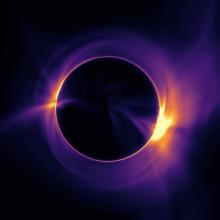
A Flicker From the Dark
While light cannot escape a black hole, the bright glow of rapidly orbiting gas has its own unique flicker. In a recent paper submitted to Astrophysical Journal Letters, UC Santa Barbara’s Sean Ressler, Lena Murchikova at the Institute for Advanced Study and Chris White at Princeton University were able to use this subtle flickering to construct the most accurate model to date of our own galaxy’s central black hole — Sagittarius A* (Sgr A*) — providing insight into properties such as its structure and motion. Read more.

A Deepening Crisis Forces Physicists to Rethink Structure of Nature’s Laws
For three decades, researchers hunted in vain for new elementary particles that would have explained why nature looks the way it does. As physicists confront that failure, they’re reexamining a longstanding assumption: that big stuff consists of smaller stuff.
Read more.