


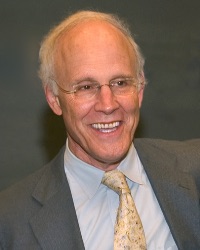
Biography
- Permanent Member and holder of the Chancellor's Chair Professor of Theoretical Physics at the Kavli Institute for Theoretical Physics
- Professor of Physics, Department of Physics at University of California, Santa Barbara, U.S.A.
- 2004 Nobel Prize Winner in Physics
David Gross received his bachelor’s degree from the Hebrew University of Jerusalem in 1962. He received his Ph.D. in physics from the University of California, Berkeley in 1966 then spent three years as Junior Fellow at Harvard University. In 1973 he was promoted to Professor at Princeton University and in 1986, named Eugene Higgins Professor of Physics there. He served as Director of the Kavli Institute for Theoretical Physics (KITP) at the University of California, Santa Barbara from 1997 to 2012 and is presently a Permanent Member at the KITP where he holds the Chancellor's Chair Professor in Theoretical Physics.
He has been a central figure in particle physics and string theory. In 1973, his discovery, with his student Frank Wilczek, of asymptotic freedom—the primary feature of non-Abelian gauge theories—led Gross and Wilczek to the formulation of Quantum Chromodynamics, the theory of the strong nuclear force. Asymptotic freedom is a phenomenon where the nuclear force weakens at short distances, which explains why experiments at very high energy can be understood as if nuclear particles are made of non-interacting quarks. The flip side of asymptotic freedom is that the force between quarks grows stronger as one tries to separate them. This is the reason why the nucleus of an atom can never be broken into its quark constituents.
QCD completed the Standard Model, which details the three basic forces of particle physics--the electromagnetic force, the weak force, and the strong force. Gross was awarded the 2004 Nobel Prize in Physics, with Politzer and Wilczek, for this discovery.
He has also made seminal contributions to the theory of Superstrings, a burgeoning enterprise that brings gravity into the quantum framework. With collaborators, he originated the "Heterotic String Theory," the prime candidate for a unified theory of all the forces of nature. He continues to do research in this field at the KITP, a world center of physics.
His awards include the Sakurai Prize, MacArthur Prize, Dirac Medal, Oscar Klein Medal, Harvey Prize, the EPS Particle Physics Prize, the Grande Médaille d’Or, the Nobel Prize in Physics in 2004, the Medal of Honor of the Joint Institute for Nuclear Research, Dubna, the Basic Science Lifetime Award (BSLA), and the Special Breakthrough Prize in Fundamental Physics.
He holds honorary degrees from the US, Britain, France, Israel, Argentina, Brazil, Belgium, China, the Philippines and Cambodia. His memberships includes the US National Academy of Science, the American Academy of Arts and Sciences, the American Philosophical Society, l'Academie Internationale de Philosophie des Sciences, the Indian Academy of Science, the Chinese Academy of Science, the Russian Academy of Sciences and The World Academy of Sciences (TWAS).
In 2016, he began a four-year term in the Presidential Line of the American Physical Society, where he is currently past President.
Awards and Honors
- NSF Graduate Fellowship, 1963-66
- Alfred P. Sloan Foundation Fellow, 1970-74
- J. J. Sakurai Prize of the American Physical Society, 1986
- MacArthur Foundation Fellowship Prize, 1987
- Dirac Medal, International Center for Theoretical Physics, 1988
- Oscar Klein Medal, Royal Swedish Academy, 2000
- Harvey Prize, Technion-Israel Institute of Technology, 2000
- High Energy and Particle Physics Prize, European Physical Society, 2003
- Grande Médaille d’Or de l’Académie des Sciences, France, 2004
- Nobel Prize in Physics, 2004
- Golden Plate Award, Academy of Achievement, 2005
- San Carlos Borromeo Award, University of San Carlos, Philippines, 2008
- Richard E. Prange Prize , University of Maryland, 2013
- Medal of Honor of the Joint Institute for Nuclear Research, Dubna, Russia 2016
- Basic Science Lifetime Award (BSLA) in Physics, Int’l Congress of Basic Science (ICBS), 2025
- Special Breakthrough Prize in Fundamental Physics, 2026
Honorary Doctorates and Professorships:
- Doctor Philosophiae Honoris Causa, University of Montpellier, 2000
- Doctor Philosophiae Honoris Causa, Hebrew University, Jerusalem, 2001
- Doctor Philosophiae Honoris Causa, Sao Paulo University, Brazil, 2006
- Doctor Philosophiae Honoris Causa, Ohio State University, 2007
- Doctor Philosophiae Honoris Causa, University of the Philippines, Manila, 2008
- Doctor Philosophiae Honoris Causa, De La Salle University, Manila, 2008
- Doctor Philosophiae Honoris Causa, University of Cambridge, England, 2008
- Doctor Philosophiae Honoris Causa, Hong Kong University of Science and Technology, 2008
- Doctor Philosophiae Honoris Causa, University of Cambodia, 2010
- Doctor Philosophiae Honoris Causa, Université Libre de Bruxelles, 2010
- Honorary Doctoral Degree, University of Chinese Academy of Sciences, 2016
- Doctor Philosophiae Honoris Causa, Universidad Nacional de Tucumán, Argentina, 2016
- Einstein Professor, Chinese Academy of Sciences, 2005
- Honorary Professor, Zhejiang University, 2005
- Honorary Professor, Xieman University, 2006
- Honorary Professor, Xian University, 2006
- Honorary Professor, ESPOL University, Ecuador, 2006
- Honorary Professor, Langzhou University, 2007
- Honorary Professor, Shanghai Jiao Tong University, China, 2010
- Honorary Professor, Xian Jiao Tong University, China, 2012
- Honorary Professor, Huaqiao University, Xiamen, China, 2012
- Honorary Director, Kavli Institute for Theoretical Physics/CAS, Beijing, China, 2006-
- Solvay Centenary Chair, Solvay Institute, Brussels, 2011
- Lee Kong Chian Distinguished Professor, Institute for Advanced Study, Singapore, 2013
Lorentz Professor, Leiden University, Netherlands, 2014