


Latest News
Newly Devised Test May Soon Confirm Strings As Fundamental Constituent of Matter, Energy
KITP Program Heralds Birth of String Cosmology
Read more
Polchinski Elected To National Academy of Sciences
Joseph G. Polchinski, professor of physics at the University of California, Santa Barbara, and KITP permanent member, has been elected a member of the National Academy of Sciences at the annual spring meeting.
Read more
World’s Top Theoretical Physicists Converge to Consider ‘Future of Physics’
Celebrating 25 Years of Santa Barbara as a Theoretical Physics Center
Read more
Solid-State Physics: Quantum Choreography Inside Crystals
Fisher Frames History of Field for Focus on Strongly Correlated Electrons
Read more
High School Teachers Need Physics Now
Some 70 teachers of physics came from throughout the United States to the KITP’s fifth conference for high school teachers — this one on “Nanoscience and Quantum Computing.”
Read more
Optimization: the Renewed Quest for a Physics of Biology
One of the main missions of the KITP is to catalyze and to promote collaborations, the hallmark of 21-century science.
Read more
Topological Quantum Computing: The Devil is Not in the Details
"Interdisciplinary" is a word that has gotten a lot of press in the past decade’s reporting on prospects for scientific discovery...
Read more
Thinking About Thinking About Quantum Mechanics
Possible Good News for Aging Quantum Physicists
Read more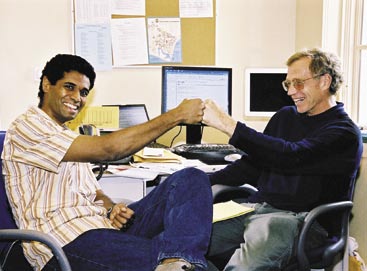
Microsoft’s Quantum Research Project Headed by Mathematician Takes up Temporary Residence at KITP
In the spring of 1997, former graduate students at the UC San Diego invited Michael Freedman, a topologist awarded the Fields Medal for his work on the Poincaré conjecture, to give a talk at Microsoft Research. At the conclusion of that talk, an employee then there, physicist Nathan Myrvold, offered Freedman a job to work, more or less, on whatever he wanted.
Read more
How to Tell a Fermion From a Boson
All particles in three-dimensional space are either bosons or fermions. What distinguishes one from the other is not a simple matter...
Read more