


Latest News
-
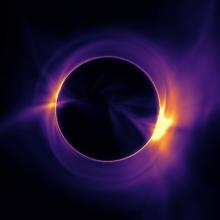
A Flicker From the Dark
While light cannot escape a black hole, the bright glow of rapidly orbiting gas has its own unique flicker. In a recent paper submitted to Astrophysical Journal Letters, UC Santa Barbara’s Sean Ressler, Lena Murchikova at the Institute for Advanced Study and Chris White at Princeton University were able to use this subtle flickering to construct the most accurate model to date of our own galaxy’s central black hole — Sagittarius A* (Sgr A*) — providing insight into properties such as its structure and motion. Read more.
-

A Deepening Crisis Forces Physicists to Rethink Structure of Nature’s Laws
For three decades, researchers hunted in vain for new elementary particles that would have explained why nature looks the way it does. As physicists confront that failure, they’re reexamining a longstanding assumption: that big stuff consists of smaller stuff.
Read more. -
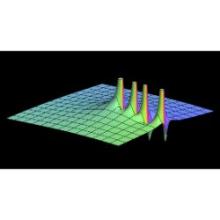
KITP Postdoctoral Scholar Grant Remmen explores new approach to the Riemann hypothesis
Grant Remmen believes he has a new approach for exploring the quirks of the zeta function. He has found an analogue that translates many of the function’s important properties into quantum field theory. Read more.
-
An Open Archive
Doug Eardley and KITP Online share 20,000+ talks.
Read more -
KITP Call for Proposals
Now is the time to submit program pre-proposals or full proposals for the 2022-2023 academic year. Our activities consist of 2-4 month focused research programs. Pre-proposal submissions need not be elaborate — a title, at least two paragraphs explaining the idea, and suggestions for 2-4 organizers and 10-15 key participants, keeping in mind KITP's commitment to diversity and inclusion of under-represented groups. If you feel that your proposed program would benefit from a four day conference, please tell us how you see such an event impacting your program.Proposed coordinators must be willing and able to spend most of the program in residence at KITP. Members of the advisory board will review these pre-proposals and encourage the development of promising ones into full proposals in advance of the late February 2021 board meeting. -
Director's Letter - Spring 2021
Now one year past the onset of the pandemic, KITP is set to re-open, hopefully by Fall 2021.
Read moreLars Bildsten, KITP Director
KITP 2021 Spring Newsletter -
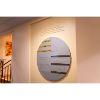
Honoring KITP’s Leading Philanthropic Investors
Introducing beautiful new donor signage at Kohn Hall and the Munger Physics Residence
Read more -
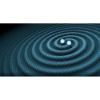
On the Hunt for Gravitons
KITP co-founder proposes a new approach in the search for the elusive graviton
Read moreHarrison Tasoff, Science Writer, UCSB Public Affairs
KITP Newsletter, Fall 2021 -
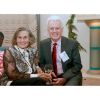
Not Both, But All
A History of Art at the Institute
Read moreMegan Turley, KITP Development Coordinator
KITP Newsletter, Fall 2021 -

Mixing Massive Stars
New research reveals hidden processes at work in the hearts of large stars
Read moreHarrison Tasoff, Science Writer, UCSB Public Affairs
KITP Newsletter, Fall 2021