


High-Precision Gravitational Waves
It is remarkable that over the past 20 years, we have seen two significant scientific discoveries: the Higgs boson and gravitational waves, both of which were made possible by monumental efforts by experimentalists and the support of forward-thinking government funding agencies. These discoveries, while pertaining to nominally different fields, shared multiple important characteristics. Perhaps most importantly, in both cases, the theoretical community had predicted them. This is in contrast to the discovery of quantum mechanics in the early 20th century, which was quite unexpected.
However, a crucial distinction between these two recent discoveries is that, while gravitational waves were predicted to exist, we did not know if they could be measured. These waves are detected by looking for small deviations, on the order of the radius of an atomic nucleus, between mirrors that are kilometers apart, and are emitted more than millions of light-years away by black holes or other astronomical objects such as neutron stars inspiraling into each other. However, prior to the discovery, there was no consensus in the community as to whether or not measurable events would occur in the career of an experimentalist. It is very hard to know how many black holes are out there exactly because they are black; we cannot count them like stars.
As such, prior to the discovery, the theoretical community working on this problem was composed of experts in general relativity. These pioneers of the field of theoretical gravitational wave astrophysics were pouring their sweat into making predictions for the expected signal for various types of inspirals. They made a bet and won. Since the initial discovery in 2016, there have been hundreds of detections, each of which needs to be analyzed and compared to theoretical predictions in order to determine the masses and spins of the merging objects. This is similar to the Higgs discovery in that we do not actually see the Higgs boson in a detector; we see its remnant. It was the theorists’ job to precisely predict what this remnant signal would be. However, in the case of gravitational wave signals, the methodology for making the predictions was not nearly as well developed as it was for Higgs boson production and detection, which had been worked on by a large community for many decades.
Predicting gravitational wave signals for binary inspirals is typically split into two pieces. The final stage is dominated by so-called “nonlinear effects’’ as the two black holes become one, which we presently only know how to handle with numerical computations. The early stage is calculated analytically, as numerical methods for this slower part of the inspiral are computationally expensive and are susceptible to error accumulation over many orbits. The numerical calculations of general relativity presented a considerable challenge to the theoretical community. It was not until a breakthrough in 2005 that the first stable simulation of a black hole inspiral was achieved. Interestingly enough, this was around the same time that it was realized that the analytic calculations necessary for the early inspiral stage could be tackled using techniques from quantum field theory (QFT)—yet another interesting connection to the Higgs predictions, which are based on QFT. The idea of using QFT techniques lay relatively dormant until the discovery event in 2016. Slowly but surely, more of the particle physics community became involved in working on gravitational wave theory, as it became clear that there were many open questions in the field that could be attacked using QFT.
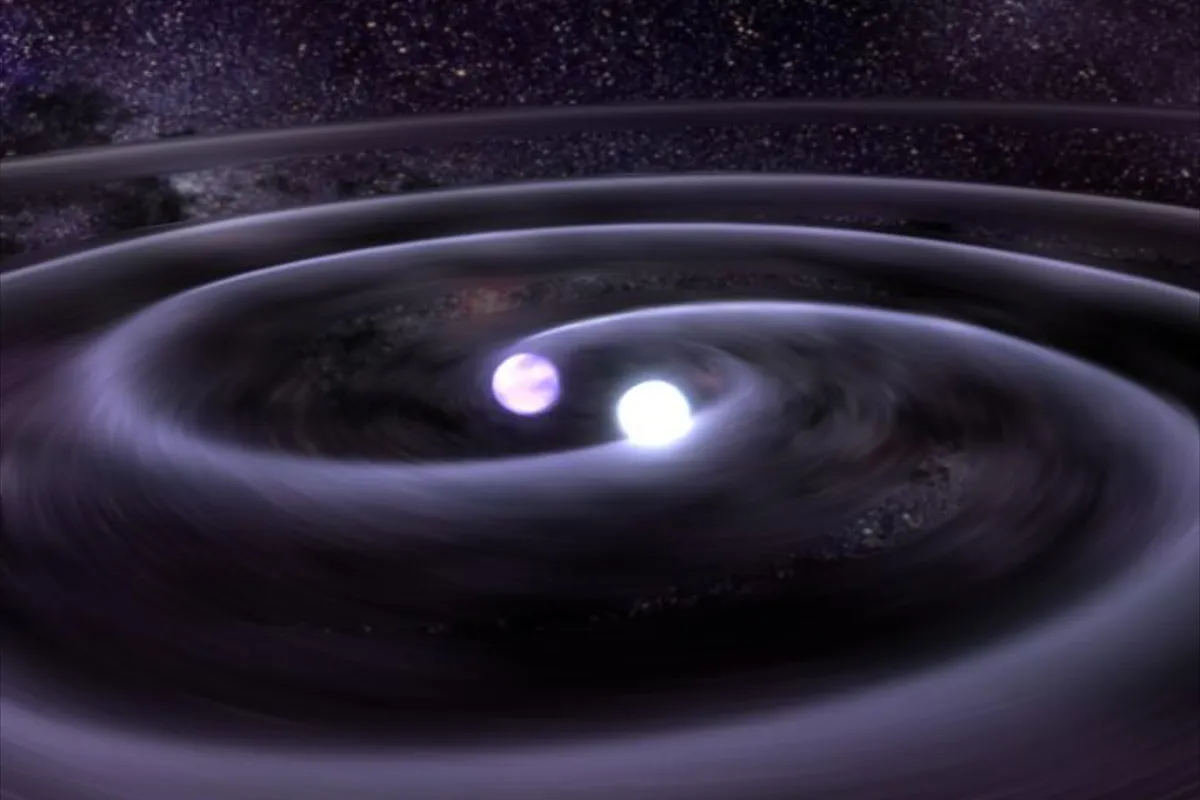
This illustration shows the gravitational waves produced by two orbiting stars in a binary system.
It was at this auspicious time that we decided to propose a KITP program entitled High Precision Gravitational Waves, which would bring together experts in gravitational wave theory and particle physics to serve as a science accelerator. Our program was approved and ran in the spring of 2022. It was, and still is, a very exciting time in the field, as scientists from various subfields of the high-energy community, including amplitudes, effective field theory, and string theory, realized that they had tools that could help generate more precise predictions.
Since then, progress in the field has been remarkable as predictions are becoming ever more precise, allowing experimentalists to extract detailed information about the properties of the observed systems. In particular, one mind-bending prediction is that black holes cannot be deformed. Planets or stars, when placed near other gravitating objects, will undergo “tidal deformations.” That is, the gravitational field of one object will tend to pull apart the other, just as the moon’s gravitational field causes tides on Earth. The idea that we can actually test whether black holes deform seems almost ludicrous, but using gravitational wave detectors, we have the potential to achieve this goal. However, the effect we are interested in is extremely small (one part in a billion) and will require incredibly precise theoretical predictions. In 2022, we were still very far away from reaching this milestone calculation, but a large communal effort involving contributions from relativists and field theorists is bringing us very close. I would not be surprised if that milestone is reached in the next few years.
That 2022 KITP program was a springboard that led to this progress. Since then, there have been annual programs and conferences that bring together these communities. So much so, that now the fields are starting to merge. I consider this a great success of interdisciplinary science that KITP enabled through its ability to so effectively convene scientists for sustained interactions.
by Ira Rothstein
Carnegie Mellon University