


For us, the KITP has come to symbolize the cementing of a deep friendship and the inception of a lasting professional partnership. At key moments it has offered a refuge from daily concerns, serving as a catalyst for clear thinking and productive collaboration.
Our first time together at the institute was during the summer of 2016. We had originally met more than a decade earlier, as PhD students at Texas A&M, and had reconnected at the end of 2015 through overlapping research interests and mutual colleagues. James was anticipating a first visit with the KITP Scholars program and Joel had one of three visits remaining. We resolved to coordinate schedules and meet up in Santa Barbara. During these two weeks, we shared an office and pushed forward on an article about coherent neutrino scattering. Beyond that, we visited, bonded, and enjoyed spending this special time together in such a conducive and idyllic setting. When a faculty opening in Physics was announced at Sam Houston State University (SHSU) for the next year, this experience was also a crucial part of James’ decision to apply.
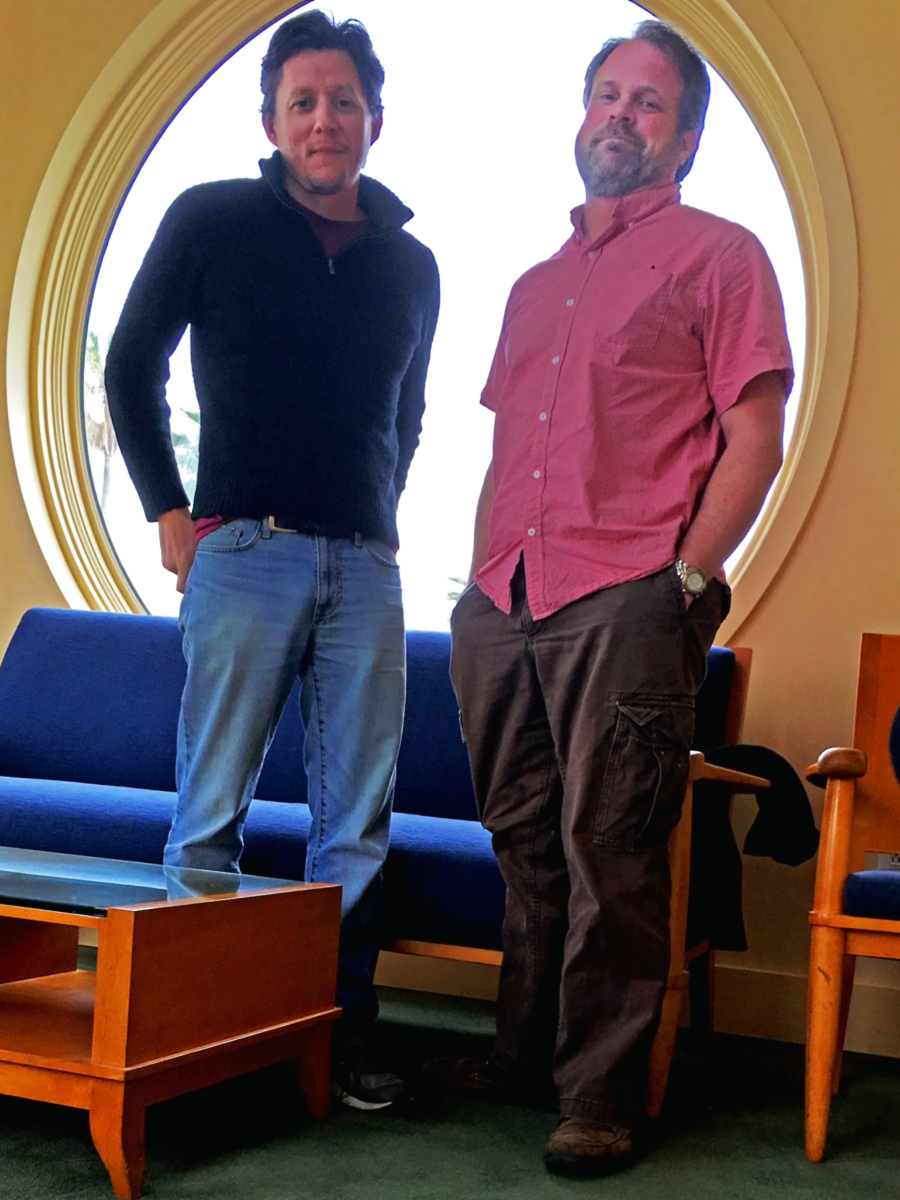
James Dent (left) and Joel Walker (right) in 2016
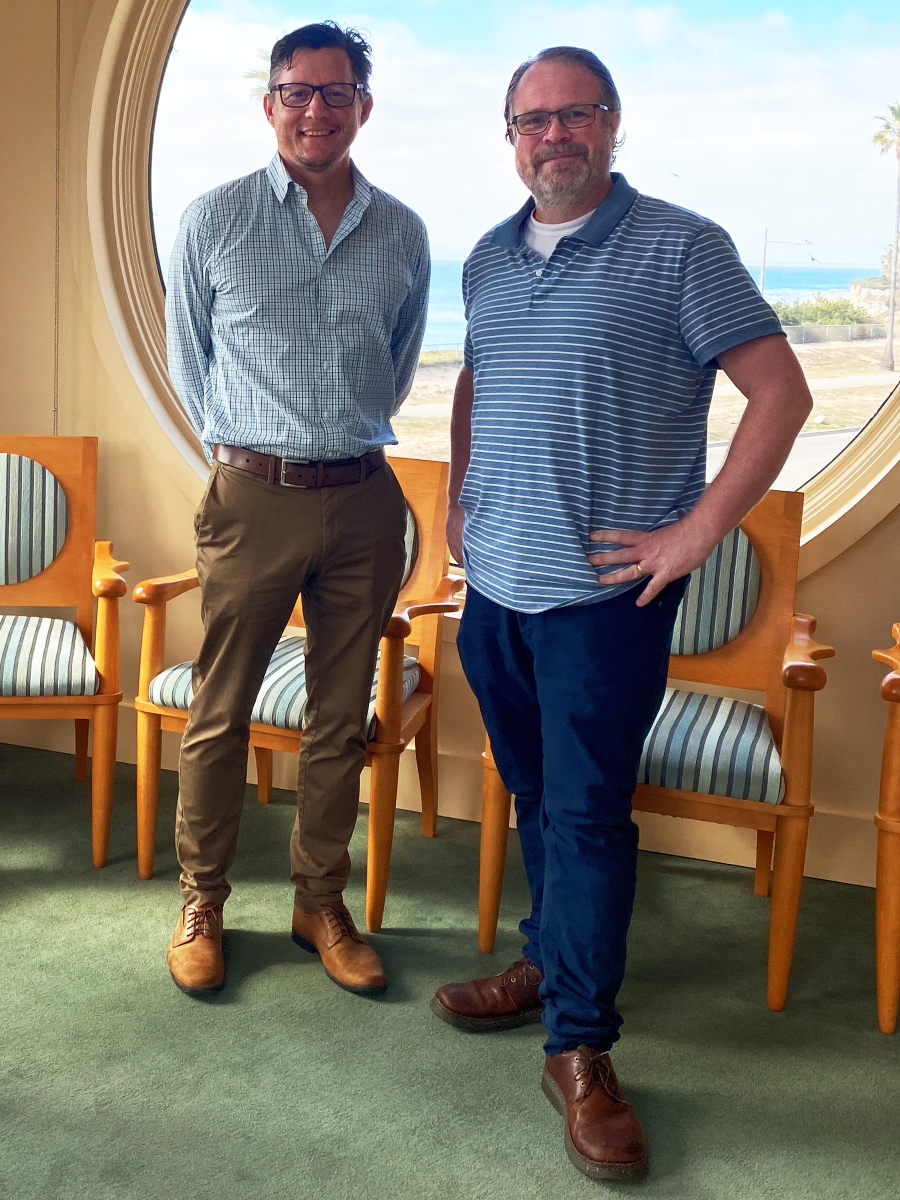
and in 2022 at KITP.
One of the first things James did after relocating to Texas was to team up on the instruction and continuing development of a new course that Joel had introduced at SHSU a few years prior. This “Physics Bootcamp” was targeted at incoming freshmen and designed to teach the mathematical methods required for first-year physics and engineering, from the perspective favored by physicists. It was motivated by challenges involving recruitment, enrollment, retention, and barriers to student success. For example, few of our students were arriving with the necessary command of calculus, while enrollment in calculus would often be delayed by stacked prerequisites, leaving many students reluctant to invest a year (or more) of effort and expense to explore the physics major. Even those students who had studied calculus often exhibited misalignment between their formal training and the practical computational skills that our courses require, lacking the ability to adapt, extend, or transfer their knowledge to new settings. Conversations with other faculty around the country convinced us that similar challenges were common almost everywhere. We resolved to package our solution for widespread reuse, in the form of a textbook.
A second pivotal visit to the KITP occurred during the summer of 2022, after five years as faculty colleagues. Significant effort had been devoted to the creation of draft content for the book, but the project had lost momentum, and it lacked a reliable publishing partner. Our time at the institute proved vital to regaining focus and charting a new path forward, clearing the way for a proposal to Cambridge University Press. After several rounds of review, which included helpful feedback regarding the project’s scope and sequencing, a contract was signed in the summer of 2023. Reinvigorated, we returned to work. Two years later, the book is now approaching its final form and is expected to be available for adoption in the Fall of 2026.

The Physics Bootcamp cover art (pictured) also has a mathematical meaning, representing a graphical proof of the Pythagorean Theorem. Image courtesy of James Dent and Joel Walker.
The Physics Bootcamp textbook is divided into five broadly-defined subject blocks: arithmetic frameworks, algebra and functions, trigonometry and vectors, differential calculus, and integral calculus. Each of these contains eight or nine short, punchy chapters on a narrow range of related topics with enough material to support one or two hour-long university lectures. This modular design makes it easy for instructors to customize their courses by selecting an appropriate window of coverage.
We are incredibly grateful to the KITP for the valuable support it has provided to our careers, and for the importance that their leadership has placed on keeping faculty at primarily undergraduate institutions involved in the activities of the broader theoretical physics research community. In particular, we are grateful for the ways in which their actions have contributed to the development of this book. And, we are hopeful that the results will be useful to the education of many future physicists and engineers for years to come.
James Dent and Joel Walker are faculty colleagues in the Department of Physics and Astronomy at Sam Houston State University in Huntsville, Texas. Dent specializes in the study of dark matter, axions, neutrinos, and primordial black holes. Walker focuses on collider physics, neutrinos, computational algorithms, and software tools. They share a mutual interest in neutrino physics. Dent was recognized as a KITP Scholar in 2016 and 2022. Walker was recognized as a KITP Scholar in 2013 and as a KITP Fellow in 2022. They are co-authors of an upcoming textbook Physics Bootcamp: Mathematical Methods for First-Year Physics and Engineering with Cambridge University Press, which is slated for publication in 2026.
by James Dent and Joel Walker